
Question? Contact us
info@simprolos.com
info@simprolos.com

When shopping for light bulbs, especially for international or online purchases, two codes often appear: E26 and E27. While these codes might seem similar, they carry significant differences in design, voltage compatibility, and safety. This comprehensive guide will help you understand the distinctions between E26 and E27 bulbs, whether they are interchangeable, and how to choose the right one for your lighting fixture.
The terms E26 and E27 refer to the type of base (or cap) used in a light bulb, specifically the Edison Screw base.
"E" stands for Edison, the inventor of the screw-type bulb base.
The number (26 or 27) represents the diameter in millimeters of the bulb's base.
Base diameter: 26 mm (~1 inch)
Standard in: North America, Japan
Voltage: 120V
Base diameter: 27 mm
Standard in: Europe, Asia, Oceania
Voltage: 220V – 240V
Though the physical size is nearly identical, the voltage requirements are significantly different—this is where compatibility and safety concerns arise.

Mechanically:
Yes. Both bulbs can physically fit into each other’s sockets because the thread pitch and diameter are nearly the same.
Electrically:
No, not always.
Using an E27 bulb (rated for 240V) in an E26 socket (120V) is generally safe, though the bulb may not perform optimally.
Using an E26 bulb in an E27 socket (240V) is dangerous, and may lead to short circuits or fire due to voltage mismatch.
💡 Tip: Always match the bulb’s rated voltage to your country’s power supply.
 Overall screw length Insulator cap height Screw diameter at thread peak Live contact pad width
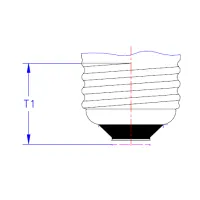 Length of Screw (MIN)
|
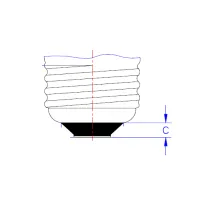 Insulator Cap Height
|
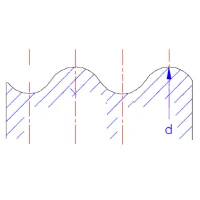 Screw Diameter at Thread Peak
|
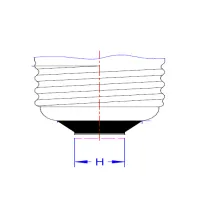 Live Contact Pad Width |
|
| E26 Light Bulb | 19.56mm | 3.25mm | 26.05mm - 26.41mm | 9.14mm - 11.56mm |
| E27 Light Bulb | 22.0mm | 5mm | 26.05mm - 26.45mm | 4.8mm-11.5mm |
The voltage difference is the most crucial distinction.
E26 bulbs, designed for 120V systems, cannot handle 240V. Using them in a 240V socket can cause overheating, arcing, and even electrical fires.
E27 bulbs are designed to withstand higher voltage and typically have additional insulation and longer screw threads to ensure safe operation at 240V.
Both E26 and E27 bulbs can fit into each other’s sockets. However, due to regional voltage standards, sockets are also manufactured to different electrical safety requirements.
✅ E27 bulb in E26 socket (if the voltage matches)
❌ E26 bulb in E27 socket (if running on 240V)
When in doubt, refer to the bulb and fixture labels or consult an electrician.
Here’s a quick checklist to help you decide:
North America (120V): Use E26
Europe, Asia, Australia (220–240V): Use E27
Look at your fixture’s voltage and socket type.
Match the bulb’s base type and rated voltage.
Both E26 and E27 bases are available in:
LED
CFL
Incandescent
Halogen
Choose based on your lighting goals and energy efficiency needs.
Measured in lumens and Kelvin, respectively.
Match your bulb’s output to the room function (e.g., warm light for bedrooms, bright white for task areas).
If using a dimmer, ensure the bulb is labeled as dimmable.
Reputable manufacturers list voltage, lifespan, and safety ratings clearly.
A longer warranty often indicates better quality.
Yes, if the bulb's voltage matches your power supply.
No, for using E26 in E27 sockets with 240V – it's not safe.

Though E26 and E27 bulbs appear almost identical, their electrical specifications make a significant difference. Always prioritize voltage compatibility and safety over convenience. By understanding these differences, you’ll make better choices for your lighting needs—ensuring both performance and peace of mind.


Comments
Leave a comment